Revision is crucial for success in exam preparation. As the students advance from Class 8 to Classes 9 and 10, the CBSE Syllabus becomes more complex and concept-oriented. In order to manage such increasing volume and at the same time perform well in exams, it is important to understand the real purpose of revision. Reading a chapter again does not constitute revision; rather, it is a systematic plan that builds memory stronger, helps in better understanding, and finally confidence in exams.
Why Revision Is Necessary for CBSE Students
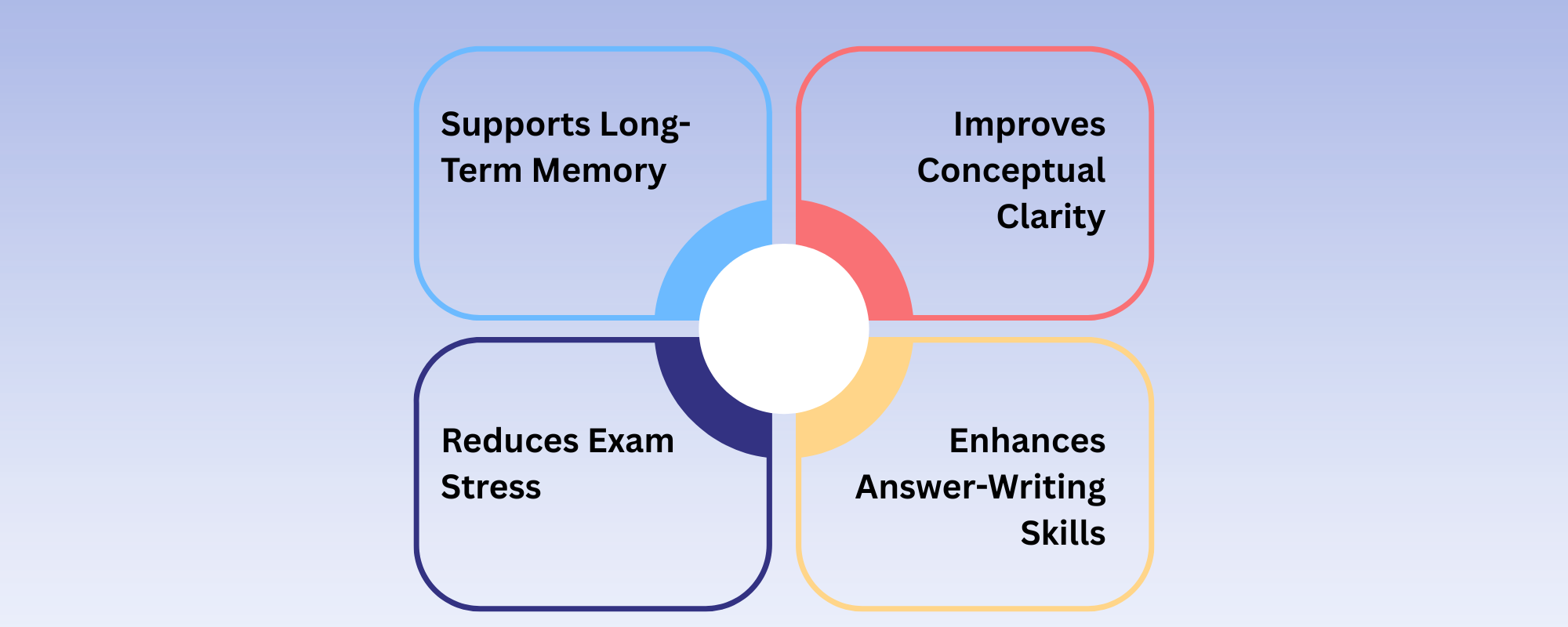
1. Supports Long-Term Memory: The CBSE curriculum promotes understanding, which is the base for Long-Term Memory, rather than rote learning. Subjects such as Science, Mathematics, and Social Science are interrelated, and hence, continuous revision enables students to transfer the information from short-term to long-term memory.
2. Improves Conceptual Clarity: Reading only once gives a very general idea. By means of revision, students figure out that there are no gaps in the studied material, they get more robust links and also understand how different aspects of the subject are interrelated. It assists them in solving application-based questions and HOTS ones of CBSE.
3. Reduces Exam Stress: Most of the exam stress is caused by the lack of full preparation. Continuous revision gets rid of the fear and increases the self-assurance as students feel ready and comfortable with the syllabus.
4. Enhances Answer-Writing Skills: CBSE tests necessitate the writing of precise, well-organized, and keyword-rich answers. Frequent revision enables students to quickly and accurately recall definitions, diagrams, formulae, and NCERT words.
Common Issues in Revision Faced by CBSE Students
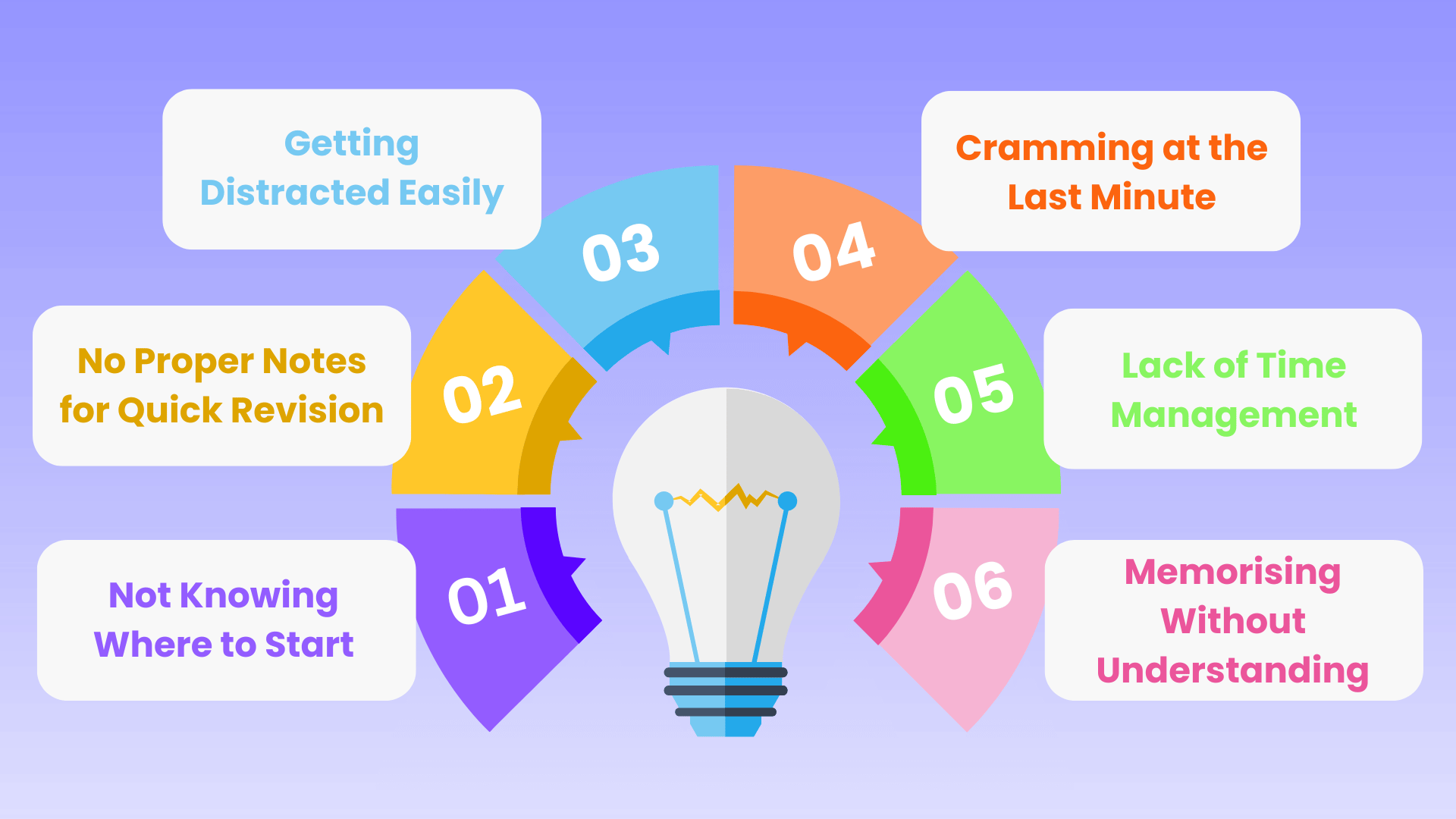
1. Difficulty Knowing Where to Begin: Due to the extensive syllabus, students are often baffled by the question of which subject or chapter they should first revise, and as a result, time gets wasted.
2. Lack of Proper Notes: In the absence of well-prepared notes, students resort to going through the entire NCERT chapters again, and thus, their preparation slows down and the effectiveness of revision decreases.
3. Frequent Distractions: Social media, mobile phones, gaming, and noise distract the students from their work and lower their revision productivity.
4. Last-Minute Studying: There are so many students who only do revision a few days before their tests, hence, they are left with a feeling of stress and a weaker remembrance of the learned material.
5. Memorising Without Understanding: CBSE papers contain questions related to analysis and reasoning. Memorisations without comprehension usually result in the mix-up of ideas and getting low marks.
6. Poor Time Management: On some subjects, people spend more time than is necessary while some other subjects are completely neglected. Such a time distribution influences one’s performance.
Effective Ways to Revise for CBSE Exams
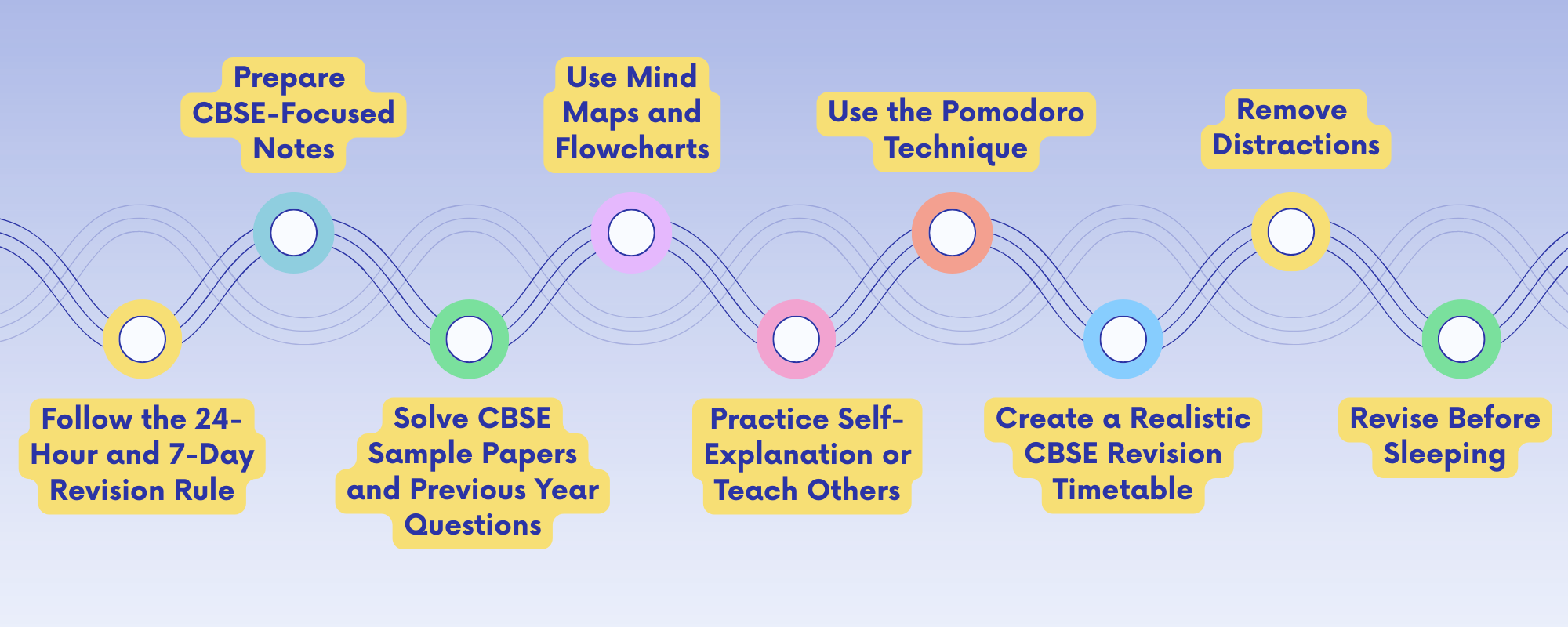
1. Follow the 24-Hour and 7-Day Revision Rule: Once you are done studying a chapter, you should review it one more time within the next 24 hours and review it again after 7 days. Such a method consolidates memory and makes forgetting less likely.
2. Prepare CBSE-Focused Notes: Prepare brief notes which encompass significant concepts, formulas, diagrams, examples, dates, and events. Expressing by your own words makes the material more comprehensible and quicker revision later.
3. Solve CBSE Sample Papers and Previous Year Questions: Working on old papers is a way to acquaint students with the style of questions, marking criteria and level of difficulty. It also helps the students in managing their time and structuring their answers.
4. Use Mind Maps and Flowcharts: Present lengthy NCERT chapters in an attractive visual form. Mind maps and flowcharts help the students grasp the overall structure of the topic and make their last-minute revision much easier.
5. Practice Self-Explanation or Teach Others: By teaching a topic to yourself, or someone else, your comprehension of it deepens and also, it is made clear which parts you need to revise more.
6. Use the Pomodoro Technique: Work for about 25 to 30 minutes and then reward yourself with a short break of 5 minutes. Such a practice keeps one’s attention at the highest level and prevents the occurrence of the so-called mental fatigue, especially, when one has to undergo a lengthy revision session.
7. Create a Realistic CBSE Revision Timetable: Allocate time considering the subjects as well as the difficulty of chapters. Having a well thought out timetable is a great tool for ensuring that one’s revision is balanced and no subject is overlooked.
8. Remove Distractions: Push your mobile farther from yourself, choose a room that is quiet for your study and make use of the apps which are created to disable notifications. The quality of revision will be improved greatly if one can create a proper and focused environment for oneself.
9. Revise Before Sleeping: Short revision done in the evening or at night has a memory strengthening effect because it is during sleep that the brain processes and stores information.

Conclusion
For students studying in Classes 8, 9, and 10 under CBSE, revision is the stepping stone to good exam results. Realizing the importance of revision, pinpointing the problems, and employing efficient strategies can not only facilitate learning but also speed up the process and make it more successful. Revision is not about putting in more time or effort; it is about being smarter in your approaches. Any student in CBSE, with regular practice and correct methods, is capable of getting excellent results in the exams.